
One ASIC, Tiny Numbers: Does the Fee Split Matter at 118 TH/s?
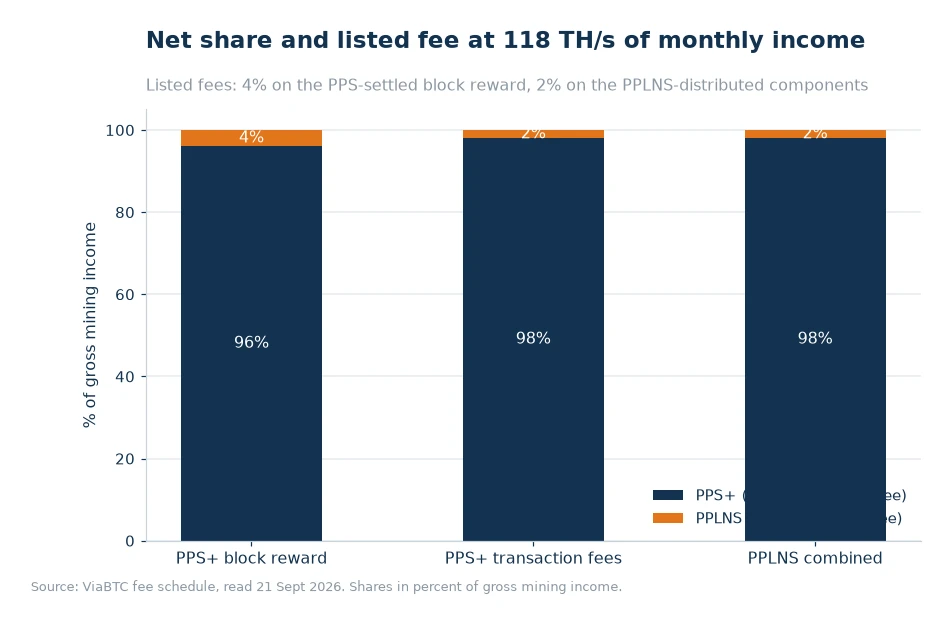
A single machine makes every percentage look like a rounding error. At 118 TH/s the gross is about $4.48 a day, the listed 4% on the block-reward component is $0.18, and the listed 2% on the PPLNS-distributed components is $0.09. Eighteen cents will not decide whether the machine runs, but it is worth knowing what it becomes over a year.
Key takeaways
- 118 TH/s produces about 0.0000529 BTC a day, or $4.48 gross and roughly $4.30 net.
- The listed 4% is 18 cents a day, which is $5.38 in a 30-day month and $65.41 across a year.
- At this size the fee is smaller than almost any other cost except the electricity itself, so choose a mode for predictability rather than for a few cents.
- One spare fan costs more than four months of the fee difference between the two rates.
What 18 cents a day actually is
Percentages scale badly in small operations because the mind reads them as proportions rather than amounts. Four percent of a large farm's revenue is a salary; four percent of one machine's revenue is a coffee. Both statements are true, and only one of them is relevant to the decision in front of a home miner.
The right way to look at it is cumulative. Eighteen cents a day is $5.38 a month and $65.41 a year. Over the three or four years a machine might run, that is a few hundred dollars, which is the price of a replacement power supply or two. Not nothing, but not the thing that decides whether the operation exists.
Four time scales, two rates
The table holds the gross at $4.48 and shows what each listed rate amounts to over different periods. The blended column applies both rates at a 10% transaction-fee share, which is the middle of the plausible range.
| Period | Gross | At listed 4% | At listed 2% | Blended 3.80% |
|---|---|---|---|---|
| One day | $4.48 | $0.18 | $0.09 | $0.17 |
| One week | $31.36 | $1.25 | $0.63 | $1.19 |
| 30 days | $134.40 | $5.38 | $2.69 | $5.11 |
| One year | $1,635.20 | $65.41 | $32.70 | $62.14 |
The year row is the one worth remembering. It is also the row that makes the mode choice feel small, which is the correct conclusion at this hashrate: pick for cash-flow shape, not for the last two decimals.
Why the percentage still deserves a look
There are two reasons it is not entirely trivial. The first is that the number is calculated on a base that moves. If bitcoin doubles, so does the fee in dollars, and a miner who budgeted 18 cents finds 36. The second is that fee comparisons between pools are only meaningful in percentages, because the gross differs by hashrate and by price. A pool charging a flat dollar amount per machine looks cheap at 118 TH/s and expensive at 1 PH/s.
So the percentage matters as a comparison tool even when the amount does not matter as a cost. Learn your effective rate, write it beside the machine's serial number, and use it when a new pool or a new mode is proposed. It is a small piece of literacy that costs nothing to acquire.
Worked example: the annual cost of 4%
Rebuild the year from the network figures.
- Every terahash accounts for 450 ÷ 1,003,000,000 = 0.00000044865 BTC in a day.
- At 118 TH/s: 118 × 0.00000044865 = 0.00005294 BTC a day.
- Dollars: 0.00005294 × 84,692 = $4.48.
- Listed 4% on the block-reward component: 4.48 × 0.04 = $0.1792, or $0.18.
- Thirty days: 0.1792 × 30 = $5.38.
- One year: 0.1792 × 365 = $65.41.
- Listed 2% for comparison: 4.48 × 0.02 = $0.0896 a day, $32.70 a year.
The gap between the two rates over a year is $32.71, which is about a tenth of a mid-range replacement fan assembly and far less than a single service visit. That is the scale of the decision.
The costs that dwarf the fee
A 118 TH/s machine drawing around 2.4 kW at 20 J/TH uses roughly 57 kWh a day. At ten cents that is $5.70, more than the gross credit, which is the real problem with a single machine and not the 18 cents. At six cents it is $3.42, leaving about a dollar a day before anything else.
Then there are the occasional costs: a fan, a power supply, a controller board, a length of cable, a replacement PSU connector. Any one of them is a multiple of the annual fee difference between the two rates. This is why advice aimed at a home miner should focus on the power tariff and the hardware's health, and mention the fee schedule as a detail rather than a headline.
It is also why a single machine benefits from a payout arrangement that avoids withdrawals eating the balance. Zero-fee mining payouts remove one of the few costs that could plausibly exceed the pool fee at this scale.
Choosing a mode when the amount is small
Two considerations decide it. The first is whether the operator needs a predictable credit. PPS+ credits hourly against current difficulty, which at this hashrate means a small amount arriving every hour and a balance that climbs in a straight line. That is easier to reason about than a variable total, and for a hobbyist the predictability is worth more than the theoretical upside of the other mode.
The second is patience. The alternative mode pays after six confirmations and shares the miner's slice over the last five difficulty rounds, which suits someone who will leave the machine alone for months. If the plan includes checking the balance daily, the first arrangement is the better psychological fit, and psychology is a legitimate input at this scale.
The ViaBTC Pool Fees page sets out both rates against their components, and a Profit Calculator run at 118 TH/s will show the daily figure with the fee applied. Two minutes of arithmetic replaces a lot of forum reading.
Keeping the record for one machine
A single machine deserves a single sheet: date, hashrate, credited coins, dollars at the price of the day, and any cost incurred. After six months the sheet answers the only question that matters, which is whether the machine is paying for its own electricity. The fee line is a row on that sheet, not a subject of its own.
Check the balance in the multi-currency wallet monthly rather than daily. At $4.48 of gross a day, daily checking produces more anxiety than information, and the monthly line is what the sheet needs.
Frequently asked questions
Does the fee split matter for a single 118 TH/s machine?
Barely in cash terms. The listed 4% is $0.18 a day and $65.41 a year, while the listed 2% is $0.09 a day and $32.70. Power, at roughly $5.70 a day on a ten-cent tariff, is the number that decides whether the machine runs.
Which mode suits a home miner best?
Usually the default pay-per-share arrangement, because it credits hourly against current difficulty and produces a steady, readable balance. The alternative suits someone who will not look at the account for weeks and can accept a variable total.
Is a small miner worth running at all?
That depends on the tariff rather than the fee. At 118 TH/s and 20 J/TH the machine needs about 57 kWh a day, so a cheap or surplus power source changes the answer far more than any pool percentage can.
Decide on power, then on fees
Write the daily kilowatt-hours and the tariff on the top line of the sheet, and the pool fee underneath. If the first line is close to the gross, the machine is a hobby with a bill attached; if there is a real margin, the fee is a detail. Either way, knowing both numbers is what stops a small operation from being run on optimism.
Sources: ViaBTC pricing, calculator and wallet pages; the schedule lists 4% against the block-reward component and 2% against the PPLNS-distributed components, read 21 Sept 2026. Chain inputs read 21 Sept 2026: network hashrate 1,003 EH/s, difficulty 132.76 T, subsidy 3.125 BTC per block, BTC $84,692. Power figures assume 20 J/TH. Published 24 Oct 2026[1].